My blog has moved to my new website, EllenKingDesign.com. Check it out! It's not quite finished but I don't anticipate that it will ever be finished. It's the nature of web design and creative work.
I've been blogging for ten years and it was time to update. See the recap of those years of blogging and what I learned.
Thanks for all the comments and support. Hope you like it.
Thursday, May 5, 2016


Sunday, January 17, 2016
My 2015 reading

For me it's booklists that always succeed in tempting me to click in. I love to see how many I've read or imagine which one will be the next great read. (Do you have a favorite book list? Send it to me!)
Inspiration
These are the lists that have inspired me lately...
- Elizabeth Gilbert's My favorite books of 2015
- Popular books of 2015 on Goodreads
- The Best Children's Books of 2015 on BrainPickings (with links to the 5 previous years lists)
- The 15 Best Books of 2015 on BrainPickings
- The 10 Best Business and Productivity Books of 2015, Fast Company
- Gretchen Rubin's (The Happiness Project) book club board on Pinterest
- BrainPickings bookshelf
- Designers and Books website
So, inspired, I took a look at the lists of books I've read. I've been keeping lists for years and have read hundreds (but probably thousands) of books in my lifetime.
It's said that what you do every day matters more that what you do every once in a while.
Of all the daily habits that have defined my life, reading is near the top for most defining. (I don't count social media fluff-n-stuff, which soaks up so much time. This year less FB and more reading FTW! )
I do count the audio books that I listen to on my commute and while doing housework. Hearing a book read aloud is a powerful way to hear the author's voice or be transported back in time or into a new world.
I don't have a complete lifetime list, which makes me sad. There was a span of life where I didn't keep track...too busy, too tired, not reading much.
But I've started to add all the books I can remember reading to my Goodreads bookshelf. Some day I'll dig out all the old early lists and catch up...or not.
I have kept track faithfully over the last eleven years, though.
By the numbers
2005 Started to keep track again
32 Average books read per year over the last 11
2010 Began listening to audio books regularly
1-5 Ratings for each book: 1- hate it, 2 - didn't like it, 3 - OK, 4 - liked, recommend, 5 - loved it, must read.
31% average for Rating 5In 2015...
41 books read or listened to (more if I had kept track of children's picture books)
11 books with Rating 5
66% Audio books compared to paper books
Genres 21 fiction (11 sci-fi), 15 nonfiction (6 memoir/bio, 3 biz), 5 YA/children
Themes Creativity, sketch art and novels about art, Neil Gaiman, Ursala LeGuin
Summer Reserved for light fluffy beach reads or YA/children's books or favorite book rereads...Crazy Little Thing, The Ocean at the End of the Lane, Eat Pray Love
Overdrive App of choice for reading or listening, because it's free with a library card (I have 2). Downside, it's difficult to find recent books on audio, or you have to wait. Can now listen streaming on the web, though. I mostly download the books so I don't trash my data plan when I'm away from wifi. Sometimes I use Kindle, but finding good free books is harder.I take notes or post gems of truth on my Twitter feed, @ellenking. I used to keep a notebook of notes and quotes and enjoy looking back through them, but it's very time consuming.
Yes, I read a real book with a yellow highlighter to catch the parts that ring true. No, I won't mark your book if you lend it to me.
I do love reading on my phone too. It's easier to read faster, just flicking through the screens quickly scanning the words. I feel like I'm making so much progress in less time. Downside, highlighting and bookmarking is possible by not convenient. And it doesn't have that book smell or weight in your hand.
Some of my favorites from 2015:

The Stoneheart Trilogy, Charlie Fletcher. Three books about a 12-year-old boy, Eddie, who runs for his life in London, and across time, to fight the strange powers that animate the statues and monuments. He finds friends and discovers his own power and strengths. This series would be a great read-aloud for your kids.

The Goldfinch, by Donna Tartt, is about a tragic accident that allows teenage, Theo, to become obsessed with a work of art and risk so much for it. It drags a bit in the middle but listening to it on audio keeps it moving along and engaging. What part does fate play in our lives? How much can we shape outcomes? How do we handle tragic grief? What power can the love of art have in our choices? "A really great painting is fluid enough to work its way into the mind and heart, in ways that are particular to you. Yours, yours, yours."


I was so motivated by these two books I ended up covering my wall with post-it notes in order to organize my ideas about where I spend my time and what I love and value. Highly recommended. (The books, not the post-it notes activity.)

We Were Liars, E. Lockhart, was such a page turner. Lie upon lie. It has a surprise ending that I didn't guess at all. Couldn't put it down.

A Kiss Before You Go was a touching memoir of love and loss after the death of his wife, done by designer and artist, Danny Gregory. So honest, so vulnerable, so touching. Taking up sketching again helped him heal and move on. Sketching is good for the soul, just saying.

You Are Stardust, Kelsey and Kim, is a beautiful children's book that reminds us of our place in the universe and our relationship to the earth. Wonderful illustrations and poetic writing. A gem to share with your child and cherish yourself.

Currently I'm finishing up Big Magic, by Elizabeth Gilbert and loving it. I like her writing style and I'm really absorbing the ideas. We think creativity is reserved for a talented few, but if you're human you're creative. It's part of what makes humans human.
This has been fun summing up my 2015 reading. Every once in a while it's good to take inventory of the things you love. Now it's time to get back to reading.
What should I read this year?
Ellen
Quoteable:
“A book is proof that humans are capable of working magic,” Carl Sagan asserted in his iconic Cosmos series, admiring the “funny dark squiggles” that have the uncanny power to transport us, across time and space, into the mind of another.Also read, Galileo on why we read and how books give us superhuman powers, at BrainPickings.
I have never known any distress that an hour's reading did not relieve. ~Montesquieu
Wednesday, August 26, 2015
About illness
 |
| My sketch of the miseries of influenza. |
I came down with a nasty strain of influenza in July. For two weeks, I was flat out in bed unable to move much, headache, body aches, fever and chills, sore throat, laryngitis, congestion, coughing,...you know, the flu. It's been a very long time since I was this sick.
I had the chance to live my Stoic philosophy. I failed in the moment, but learned much.
If you didn’t learn these things in order to demonstrate them in practice, what did you learn them for? ~EpictetusStoicism (not the "stiff upper lip", stand-and-take-it with no emotion kind) is an ancient Greek and Roman philosophy with some coping techniques for the ups and downs of life. One outcome is increased positive emotions and decreased negative emotions. Another is peace of mind.
You seek through virtue (courage, temperance, justice, wisdom) and logic to respond to life in a way that helps you find happiness in adversity.
One exercise is to imagine a loss, or being without, for a brief time every day, and then through the day keep that perspective in mind, along with thoughts of gratitude. This helps you not take for granted what you have (job, possessions, family, friends, health) and prepares you for the certain losses that life brings.
Among other techniques, you manage your emotions and achieve peace of mind by evaluating what you can control and what is beyond your control, and through practice, learning to become indifferent to that which you cannot control.
In theory.
You definitely can't control the flu. I was not indifferent.
I was miserable, complaining that it wasn't convenient, that it never let up, that I was taking too long to get better. I was counting the minutes and dreading the night. My emotional misery added to my physical misery. It was only after I finally gave in and rested, and did what I needed to do to get better, that a bit more peace of mind came to me. I eased up on my own expectations.
Things do not touch the soul, for they are external and remain immovable; so our perturbations come only from our inner opinions. ~Marcus AureliusForced suffering teaches.
I learned that not as much matters as we think it does. Your health is a precious thing to appreciate and protect above all. It can be worse quickly. We are all temporarily able-bodied. Wellness will be more appreciated.
‘Being healthy is good, being sick is bad.’ No, my friend: enjoying health in the right way is good; making bad use of your health is bad. ~EpictetusI learned that our stuff, our things, what others think, and the events that happen around us should all fall into a low priority, really, illness or no. Keeping that perspective is important to peace and well-being.
Being attached to many things, we are weighed down and dragged along with them. ~EpictetusI had confirmed clearly that I am too soft and spoiled, and privileged, in my life in general. More Stoic practice is needed.
“But my nose is running!” What do you have hands for, idiot, if not to wipe it? “But how is it right that there be running noses in the first place?” Instead of thinking up protests, wouldn’t it be easier just to wipe your nose? ~EpictetusI became grateful for food, water, a deep breath of air, throat drops, ice, soft Kleenex tissue and sleep. I've just been rushing through life, not paying attention to or appreciating the simple act of living.
Very little indeed is necessary for living a happy life. ~Marcus AureliusMoments of ease between pain are precious. Living more in those moments extends them.
The present is the only thing of which a man can be deprived, if it is true that this is the only thing which he has, and that a man cannot lose something he does not already possess. ~Marcus AureliusLoved ones and friends became more dear. Their concern and kindnesses however small were so welcome. We need to treat each other with more TLC.
To care for all men is according to man’s nature; and man should value the opinion only of those who openly live according to nature. ~Marcus AureliusAnd, I didn't get worse. I'm still here among the living. I didn't get bronchitis, pneumonia, sinus infection, strep throat, dehydrated or a list of other complications. I very Stoic kind of appreciation.
It isn’t death, pain, exile or anything else you care to mention that accounts for the way we act, only our opinion about death, pain and the rest. ~EpictetusI feel changed, clearly, and don't think I'll be the same again. Unless I forget.
How quickly things disappear: in the universe the bodies themselves, but in time the memory of them. ~Marcus AureliusMy duty is clear.
Remember.
For the next time, for others. To be more "artful", to be more philosophical in practice than in theory.
Read more about Stoicism:
How to Be a Stoic, Massimo PigliucciIndifference is a Power, (Or why Stoicism is one of the best mind-hacks ever) Lary Wallace
Stoicism 101, How to be a Stoic
Stoic Ethics, Internet Encyclopedia of Philosophy
Thursday, April 23, 2015
My Pastry Box article is live
On a whim last New Year's Eve, and with encouragement from a friend, I pulled together some thoughts on Sketching. It's just been posted on the Pastry Box! Check it out.
While my writing skills have improved a lot over the years, it remains a challenge to get what I want down on paper. See if you think it's coherent.
I'm a bit disappointed in the quality of the cover photo. Ah, deadlines and technology.
All in all I'm pleased. Hope you are too.

While my writing skills have improved a lot over the years, it remains a challenge to get what I want down on paper. See if you think it's coherent.
I'm a bit disappointed in the quality of the cover photo. Ah, deadlines and technology.
All in all I'm pleased. Hope you are too.
Tuesday, January 20, 2015
A Word of the Year
(Hey, look what I found in my drafts folder! Too late for a resolutions post?)

A word of the year works for me.
Rather than a list of resolutions that are more wishes than determination to better myself, I choose one word every January to guide my life for the year, to send me off in one direction.
It's not an original idea.
I trace it back to a post on the Happiness Project blog a few years ago about setting the tone for the year, and this one with a video about choosing a one-word theme, and this recent one that I just discovered, one-word theme.
Then there's this author who believes you can change your life with just a word. (Haven't read it, so I can't recommend it, but it seems like a popular idea.)
My daughter told me she was doing it as a way to simplify and still move forward, and, of course, remove the guilt when resolve usually fails.
Who needs one more thing to fail at, feel bad about, or stress over? Not I.
How I choose
Every year I ponder on something that I think will benefit me personally and possibly others. I try to keep it broad, but not nebulous; focused and measurable, but not restrictive and too defined. I ask others, but not to copy, just to be inspired. I make lists, look at a thesaurus and dictionary sometimes, but essentially it just comes to me at a random moment.The implications
I like this one-word approach because I already put a lot of pressure on myself to succeed and improve, and I don't need the extra pressure of a long to-do list. Besides, at this point in life I've exhausted the long lists (either as impossible, fruitless, or trivial).So here's why I choose just one word:
- It's easy to hold in my mind.
- It can apply in so many ways.
- Anticipating how it will manifest is half the fun.
- Every year can be a success.
- The outcome usually surprises me.
A few examples

One year I chose Color. I felt life was a bit drab, a bit boring, a bit colorless.
So I focused on buying fewer gray or neutral pieces of clothing and more items with color. I didn't realize that I was always pulling beige-colored or gray pants off the rack to try on.
I live in a house with beige carpets and off-white walls. So I took a risk and bought richer curtains, rugs and towels, and a red chair!
More colorful food is better for you, richer in vitamins and variety, better for digestion and cancer-fighting goodness, instead of the processed, soft, white, starchy diets many of us have. I choose colorful food.
That word color continued with me through the years since that first one. I think about color more and not just in clothing, food and home decor. Color lifts my spirits. I look for that really blue sky in October and really green grass in May (and the azaleas!)1 and all the shades and seasons in between. I notice the "pops" of color that make life good and interesting.
The point was to get out of my comfort zone, or climb out of a rut or two, and get some variety and zest into life.

The year I chose Authenticity, I strove to bring my home self, my work self, my church self, my family self and my inner self more into alignment.
I stopped myself from pretending when I didn't really feel it, and smiling when I didn't want to (or when someone told me to!). I started keeping quiet when my opinion wasn't really needed, and speaking up when it was important.
I cherished real life moments (good and bad) rather than rushing to the next thing or wishing away a situation. A lot of healthy goodness came from that year.
For example, it was a relief and a revelation when I finally said to self and family I hate to cook. In our culture it's just assumed that women like to cook and nothing pleases them more than feeding their families. And for some that is true. I gave up trying to fit a mold when it comes to cooking. I now put together nice, simple, balanced meals to nourish us, but I'm equally fine with picking up prepared meals on the way home from work, eating leftovers, or warming something from a can. It's all good and doesn't reflect on me personally, or as a wife and mother.
The point of Authenticity is that my thoughts and opinions are a valid as any other, how I express myself in word and dress and action is unique. My preferences are mine, and I value those ideas.

Last year I chose Truth. As the year unfolded I did a lot of pondering and listening to my heart and soul for answers. I ended up writing in a journal a lot more than I have in years. It was so good to take the time I needed to just think about what's important in life and to me. I knew I had a whole year to figure a few things out and I wandered (and wondered) down many avenues of thought, sometimes aimlessly and sometimes with dogged determination.
What felt serious and heavy at one point gradually flattened out, thinned, and dissolved away. I equate the feeling to a Bible scripture, John 8:32, "and you will know the truth, and the truth will make you free."
The point is that some things can't be forced, but need time to mature or resolve. A year to focus on one word provides that for me.
If resolutions don't work for you or you just don't want another thing to do, give a Word of the Year a try, instead.
Share with me and I'll give you a thumbs up and whatever cheering and validation you need.
Sunday, November 23, 2014
10 Ways to Sketch More

Sketching is good for the soul
At least it's been good for my soul lately. So it makes sense to sketch more.Pablo Picasso said,
"The purpose of art is washing the dust of daily life off our souls."So let's wash some dust off and get more art into our lives.
Draw/paint/sketch/photograph something that inspires you
Be inspired by the ordinary, by the light on the patio after a rain, or by something you already love in the corner of your world.I love that my phone is my camera and always with me. I love taking pictures of the ordinary and elevating it to art by finding an interesting composition, color, angle, or close-up. Then I sketch it. Right then or later from the photo.

Inspiration is anything that makes me say "that's cool" or "that's interesting", or "I'll bet nobody has really looked closely at that." Maybe you like flowers, cats, architecture, lemons or cars. Draw it. You'll see it in a new way and love it more.
Let go
In another life I used to paint and craft, but other priorities took over for a time. I so missed being creative. I didn't realize how much until I started in again. So, I recently let go of a few things...a long to-do list that was never done, house-cleaning expectations, home cooking (not my thing), too much media, others' ideas of how I should spend my time and the need for perfection...to take up the pen and paint again.Let go of anything that doesn't feed your soul. (And, no, sleep doesn't count...get your sleep.)

Start small
I bought a cheap sketchbook and a travel set of paints and a water brush and began to work the dustiness away, by doing small sketches. Use what materials you have, try different pens and pencils and paints. Do several small studies. And embrace wonkiness, and imperfections and learn from them.
Share with friends
Begin sharing with social media friends on Instagram or Flickr or Facebook. Your friends will say encouraging things or "like" it and that will give you a boost. Share the good...
... the bad and the ugly. It keeps you humble and learning.

Sign up for an online class
I signed up for an Alisa Burke online class, Flower Power, last spring to do something simple and unintimidating. She explores so many different styles and is full of never-ending creativity. Her classes are reasonably priced to get started with.

I know that my motivation comes from a class-type setting where lessons and assignments give me something to look forward to and goals to meet.


Find inspiration in unusual places
These reading notes from a (rather dry) book on the golden ratio, The Story of PHI, just had to have a sketched illustration. I love math, and combining it with art made sense to me. I definitely looked very closely at this sunflower as I was drawing it, and even counted the spirals of seeds. Yes, 34 going one way and 55 the other.Draw something you love already, but might not be related to art.

Make something you'll see everyday
Stretch beyond the paper. Make a craft. Use different paints. Paint big. Paint on wood or fabric. Bloom where you are planted.
Get away from home
When you travel you get a bump in creativity. Neuroscientist Jonah Lehrer, in his book, Imagine, says "when you escape from the place you spend all your time, the mind is suddenly made aware of all those ideas previously suppressed. You start thinking about obscure possibilities." My mind is definitely in a good place on vacation.

So this makes sense now too..."a relaxed state of mind allows us to look inward toward a stream of remote associations in our right brain...insights come in the shower, when we are in a positive mood, when we are not looking for an insight."

But really it's just that "Life is better at the beach". --Kitschy sign from the beach bum store

There's nothing to do but sit and listen to the waves and the wind, and enjoy the sun. (Ah, letting go of that to-do list again.) Get away to a new place and sketch what you see.

Experiment with a different technique
White sharpies are thing? Yes! This is just a piece of cardboard with drippy sloppy colors (let dry), and then a crazy white doodle on top. Batik-like. Just for the fun of it.

My birdhouse gourd (that has yet to become a birdhouse) was a last minute purchase from the farm market. It's done with acrylics base paint, then black paint and Sharpie used to make the look of lace.

Commit to sketching often
It wasn't until a friend encouraged me to #sketchmore during the month of November in support of her NaNoWriMo goals, that I realized how much I could get done, how it's helped me improve, and how good it really is for my soul. Do something every day.
Bonus tip: Do what you like
Be yourself. Enjoy your own style. Don't care what others think. Choose a quote from one of these philosophers to remind yourself...Be yourself; everyone else is already taken. --Oscar Wilde

Wanting to be someone else is a waste of who you are. --Kurt Cobain

Where is your will to be weird? --Jim Norrison
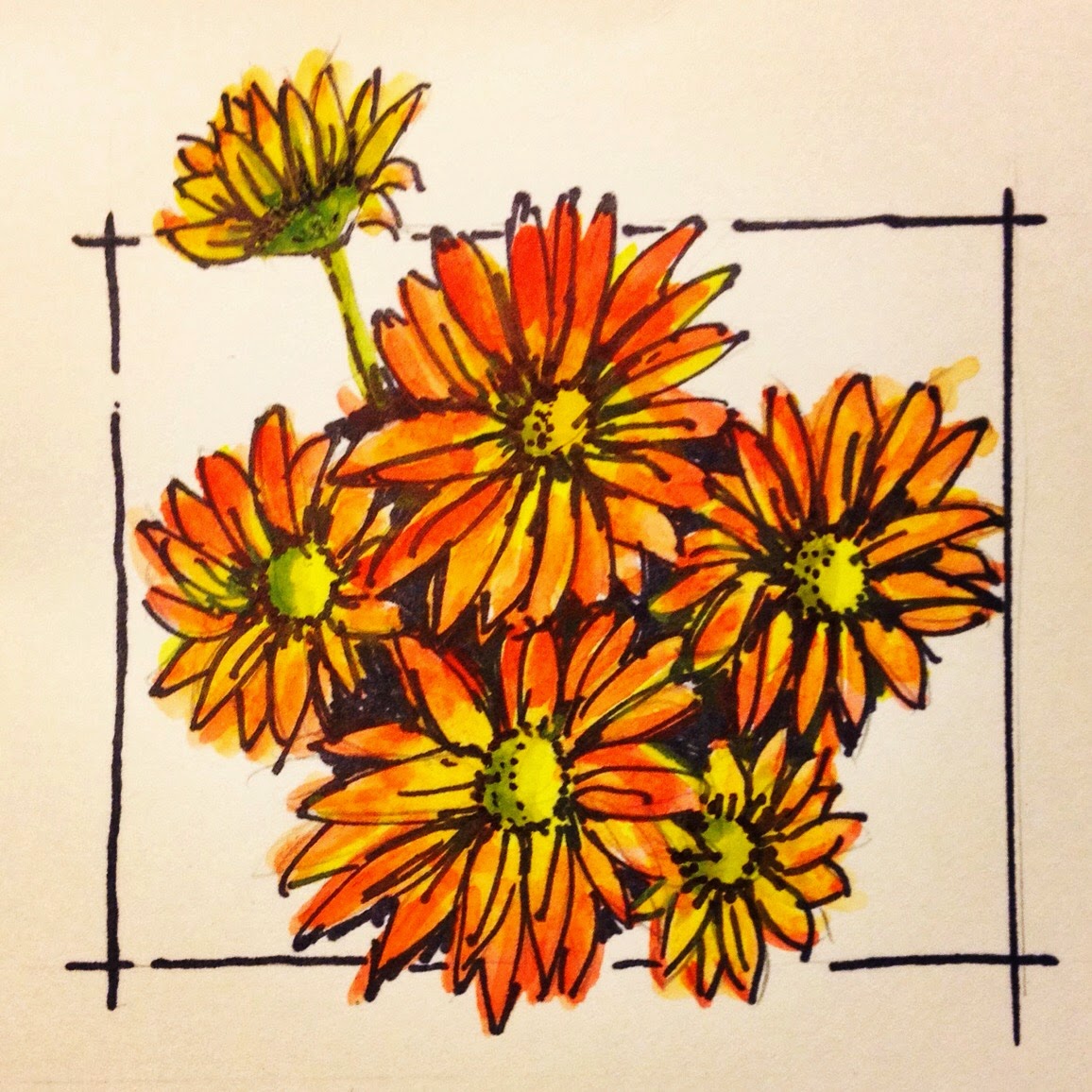
Just be yourself, there is no one better. --Taylor Swift

This one is my favorite because I'm my own worst critic.
If you hear a voice within you say 'you cannot paint' then by all means paint, and that voice will be silenced. --Vincent Van Gogh
So silence the inner critic, dust the daily life off, see how it feels. Good for the soul?
Monday, August 25, 2014
Making your website accessible is just plain the right thing to do
 |
| Bridging a barrier |
I've spent a lot of my work life and free thinking time this year teaching myself (and others, one coworker at a time) the principles and skills of web accessibility, to be applied first on a simple low-risk pilot project, and then so I can be positioned to make a difference when my company finally commits to it whole-heartedly.
Making web content easily available to people with disabilities will take institutional will and know-how.
But mainly will.
Don't tell me it doesn't fit in with the mission, target audience or business needs. I design and manage web projects for the main website of a major financial institution whose mission is to take a stand for their clients, to treat them fairly, and give them the best chance for success. But for all it's altruism, it has yet to get on board fully with coding, design and writing practices that would make it's content available to all people regardless of their technology or disability.
Don't tell me there isn't time or money in the budget. I've just rolled off a 5-year multi-million dollar infrastructure and user interface project where commitment to one internal goal was paramount, but little thought or support was given to complying with basic accessibility guidelines for users.
So I find myself wondering about how large institutions become motivated to take on change.
Where is the will?
I found this excellent WebAIM article, Hierarchy for Motivating for Accessibility Change, which made me wonder if any of these approaches would work at my company.
- Guilt: See above. It is so perfect with our mission, and we've had the opportunities that we've passed up, so why not make it a priority like other projects we've done recently.
- Punish: We could be sued. Others in our industry have recently and the Department of Justice has become increasingly involved.
- Require: The 1990 Americans with Disabilities Act "places of public accommodation" phrase could be interpreted to mean websites, which would require companies who do business on the web to make their websites accessible to those with disabilities. Or, maybe we should just declare that we are making this a company standard and it will become a part of job expectations tied to yearly performance evaluations.
- Reward: Being accessible will give us a competitive marketing advantage...we'll be able to earn/tout industry certification. Or, we'll strengthen loyalty to the brand and our net promoter score will go up. Or, we'll broaden our client base and that means more money coming in.
- Enlighten: Cleaner simpler code is better for SEO and gets us better Google rankings. Or, it makes for better future readiness as new technologies come along. Accessibility is a side effect of technical excellence.
- Inspire: It is about taking a stand for people, treating them fairly and giving them the best chance to succeed. So let's see it make a difference in the life of an individual. I'll bet you know someone with a disability who could benefit from our great company philosophy. And, 50% of our clients are over age 50, but they own the lion's share of our assets. Let's make it easier for older eyes and improve their experience. Let's make it more accessible to both clients and prospects. It's just plain the right thing to do.
Tuesday, May 27, 2014
Meaning in our lives and work
I started blogging in 2006.
The thing I like best about those first posts were the quotes that related to the topic. Here's one from this early post.
They feed us better than the barrage of words and messages we receive every day through the media, our interaction with technology or the marketing messages vying for our attention.
I'm a designer in the worlds of finance, marketing and technology. It's my job to make your experience on our website a pleasant one, a trustworthy one, a (dare I say) delightful one. The challenge is to make the empathy I feel for you and your experience evident to you through the design and technology. Believe it or not there are many of us who care deeply about getting it right in all the big and small ways that are meaningful. So that we can connect with one another. So that our work and your experience are meaningful to both of us.
I ended that early blogpost with this.
I still believe that.
The thing I like best about those first posts were the quotes that related to the topic. Here's one from this early post.
Quotable
“The least of things with a meaning is worth more in life than the greatest of things without it.”
It's true. The small meaningful gestures, words, and acts of kindness of those around me are worth a lot to me. Those connections make life meaningful.—Carl Jung, “Modern Man in Search of a Soul”
They feed us better than the barrage of words and messages we receive every day through the media, our interaction with technology or the marketing messages vying for our attention.
I'm a designer in the worlds of finance, marketing and technology. It's my job to make your experience on our website a pleasant one, a trustworthy one, a (dare I say) delightful one. The challenge is to make the empathy I feel for you and your experience evident to you through the design and technology. Believe it or not there are many of us who care deeply about getting it right in all the big and small ways that are meaningful. So that we can connect with one another. So that our work and your experience are meaningful to both of us.
I ended that early blogpost with this.
The future of successful design is not in new technologies alone,
but in connecting with users to make meaning in their lives.
but in connecting with users to make meaning in their lives.
I still believe that.
Thursday, May 15, 2014
About web accessibility from the experts at WebAIM.org

I've been buried for the last 6 months in teaching myself all about web accessibility (A11y), what it is, how it benefits others and how to achieve it.
Recently I attended the WebAIM 2-day training on the Utah State University campus in the beautiful Logan, Utah, to finally check my knowledge and fill in any gaps.
I'm pleased to say I know a lot about accessibility already, had a few misconceptions cleared up and dove into ARIA tagging.
I tweeted all my notes to share in real-time with colleagues.
Here is the Storify version, as a recap. Enjoy!
Tidbits from A11y training at WebAIM - Day 1
Day 1 continued
Day 2
Sunday, August 25, 2013
You shouldn't read about French cooking when you're hungry

I finished My Life in France, by Julia Child, today.
I'm extremely satisfied and a little sad. I've carried that book with me to the beach, twice, to Utah, twice and to Georgia.
I usually devour a book within a week or two, but not this one. It was to be savored.
The way she speaks, the way she describes her surroundings, her friends, her food and her cooking.
I would read a page or two and daydream about the experience, or imagine the taste of food.
I can almost taste her first meal in France:
It had arrived whole: a large, flat Dover sole that was perfectly browned in a sputtering butter sauce with sprinkling of chopped parsley on top. The waiter carefully placed the platter in front of us, stepped back, and said: "Bon appetit!"
I closed my eyes and inhaled the rising perfume. I then lifted a forkful of fish to my mouth, took a bite, and chewed slowly. The flesh of the sole was delicate, with a light but distinct taste of the ocean that blended marvelously with the browned butter. I chewed slowly and swallowed. It was a morsel of perfection.Of her country cottage, "La Peetch" in France, she says:
Bumping up the rutted driveway, we were struck, by...the shockingly fresh and inspirational jolt we got from our lovely hideaway. It was the cool, early-morning layers of fog in the valleys; Esterel's volcanic mountains jutting up out of the glittering sea; the warming Provencal sun and the bright-blue sky; the odor of earth and cow dung and burning grapevine prunings; the colorful violets and irises and mimosas; the olives blackening; the sound of little owls talking back and forth; the sea-bottom taste of Belon oysters; the noisy fun of the marketplace, the deeply quiet, sparkling nights with a crescent moon hanging overhead like a lamp. What a place! (p. 340)I love that she was optimistic. In moving nine times from country to country she would first set up her kitchen, then take time to learn the language well enough to shop in the markets, and then build friendships through her dinner parties. She made friends with the market vendors, and got to know the local restauranteurs as well as ventured into the countryside.
She and her husband, Paul, valued their friendships. At a particularly busy time in their lives, she recalls:
"I just don't know if we have the time for a trip to France right now,"I sighed. Paul nodded.
But then we looked at each other and repeated a favorite phrase from our diplomatic days: "Remember, 'No one's more important than people'!" In other words, friendship is the most important thing—not career or housework, or one's fatigue—and it needs to be tended and nurtured. So we packed up our bags and off we went. And thank heaven we did! (p. 329) [It was on that trip they decided to build a small house in France for a getaway.]I love that she loved her work and threw herself into it, to a good old age.
As always, my work gave my life form, forced me to be productive, and helped me keep a good balance. (p. 406)I love how thorough she was in her research of ingredients and the testing of recipes.
I knew my slow, careful approach drove my intuitive co-author crazy, but it was the only way I knew how to work. I was basically writing these recipes for myself. And I was the type of person who wanted to know everything about a dish—what worked or didn't, why, and how to make it better—so that there would be no unsolved questions in our master recipe. (p. 341)
The ingredients for bread were always the same: flour, yeast, water, and salt. But the difficulty was that there were ten thousand ways of combining these simple elements. Every little detail was important, we learned: the freshness of the yeast, the type of flour, the time of rising, the way one kneaded the dough, the amount of heat and moisture in the oven, even the weather. (p. 344)I love that one of her proudest achievements was perfecting the French bread recipe. It ranks #2 on her list of 100 favorite recipes.
She thought good cooking should take time and care. She truly believed that good French food was an art.
But a careful approach will result in a magnificent burst of flavor and a thoroughly satisfying meal, perhaps even a life-changing experience. (p. 413)I loved how real she was. She knew it sometimes didn't turn out. And she kept a sense of humor.
One of the secrets, and pleasures, of cooking is to learn to correct something if it goes awry; and one of the lessons is to grin and bear it if it cannot be fixed. (p. 327)Hat tip to Carrie for suggesting I borrow her book to read. It's a little more dog-eared, sorry. It made me happy for a long time.
So hungry now for good, real French food.
e
Videos of Julia cooking
The French Chef - French bread
So informative. (I think I learned to make this in my 7th grade Foods class with Mrs. Fisher. Who knew.) Love the bit with the professional baker in France. "As soon as it thumps, you think that it's done. But it ain't. Turn the oven off and let it sit for 5 more minutes...It's just a matter of practice!"
The French Chef - Boeuf Bourguignon (black and white)
"I find these wooden spatulas awfully useful." "These wire whips are awfully useful." I think this is one of her very first episodes. The lighting has weird shadows, the camera angles are off, and there's a washer and dryer in the background. The studio scheduled for the taping burned to the ground beforehand, so the Boston Gas Company loaned them their demonstration kitchen to shoot those first shows. She had to work on an electric stove, which she detested.
The French Chef, the Lobster show (in color)
How to cook it and how to eat it. They must be lively because they go off so easily. (Holding a lobster flapping his tail) "He's a kinda a boy worth buying." About the lobster's stomach...it's called the lady because it looks like a little lady. Someone told us about it and sent one to us in an envelope.
The French Chef, Omelet
Use the right pan, 20 seconds, 2-3 eggs, a bit of water, hot pan. Swirl, jerking till it turns over on itself. "If no one is watching you can take you hands and push the edges together if it's not well formed." (Someone laughs in the the background.)
A&E Biography
"Groundbreaking for cooking shows." "She's a national icon.""She was incredibly optimistic. That goes a long way. You can get a lot done." "Incredible energy. That's her secret." ...BUTTER!
Sunday, July 28, 2013
When you find what you love, follow it with passion
 |
First Thought Films / Zeitgeist Films
|
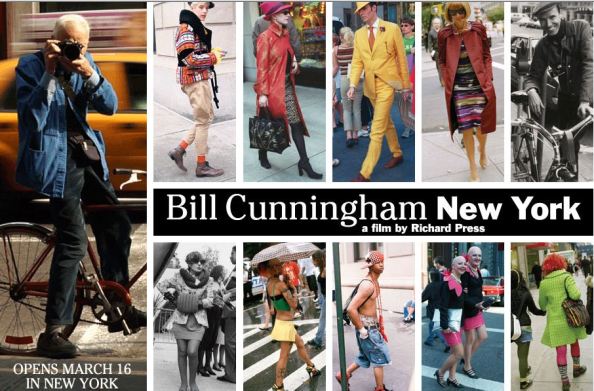
Bill Cunningham's "On the Street" NY Times column, highlights fashion that he snaps with his camera from his bike on the streets of New York City. Down through the years (nearly 50!) he has chronicled the New York fashion scene as demonstrated by ordinary New Yorkers (and some extraordinary) every day.
He begins by letting the street talk to him. When an idea emerges, he begins collecting. Sometimes he'll get an idea and start looking. He could be looking for 20 trends at once!
 |
| Joy Sewing, "Even if you shrug off fashion as a frivolous indulgence, Bill Cunningham’s energy and dedication is infectious. He makes you care. " |
I recently watched the Bill Cunningham New York documentary on Netflix. I give it a two thumbs up, and more thumbs if I had them. It's a must-watch! Watch the trailer below.
He's a fascinating man, getting on in years and still spending his days on the streets of New York and at charity and social gatherings in the city. He wears his signature blue smock (to protect the few clothes he does own from the camera equipment). He is on his 29th bike because the 28 before have been stolen. He has never "eaten in", in his small apartment over Carnegie Hall. He never goes to the movies and has never owned a TV. He has never been in a romantic relationship. He loves his work instead.
He tells a story about...
...this woman I had been photographing on the street. She wore a nutria coat, and I thought: "Look at the cut of that shoulder. It's so beautiful." And it was a plain coat, too. You'd look at it and think: "Oh, are you crazy? It's nothing."
Anyway, I was taking her picture, and I saw people turn around, looking at her. She crossed the street, and I thought, Is that? Sure enough, it was Greta Garbo. All I had noticed was the coat, and the shoulder. "I never bothered with celebrities unless they were wearing something interesting."
 |
| Fashion icon Isabella Blow is photographed on March 20, 1999. |
He lives an unencumbered life and has done much of his work for free, after hours. He says that if you never take money for your work, you can do as you please.
"Money is the cheapest thing," he says. "Liberty is the most expensive." Blithely, he conducts his life with an absence of material possessions.
 |
| His studio/apartment over Carnegie Hall is filled only with filing cabinets of his work. |
He's modest about his work and his talent. "It's not photography. I'm just documenting what I see. I let the street speak to me."
 |
| Bill at Fashion Week, Wikipedia |
And he does tell it as he sees it in the New York Times, in this recent video, for example. (There is a library of videos there, that you really ought watch. His personality is wonderfully evident.)
 |
| "Hello from the baked Apple...it's 100 degrees and fashion holds its own ....all in black and they're not going to give it up even in the heat." |
And the street speaks back:
Anna Wintour, editor in chief of Vogue:
I don't know how many times he has taken my photograph, but we all dress for Bill. You feel he's the only one who notices or cares how you dress. I wonder if Bill will like this. And it's always a flattering picture he chooses.

He honestly says of himself:
I'm a hack...I'm not really a photographer...most of my pictures are never published. I just document things I think are important. ...I do everything, really, for myself.

Others who find him inspirational too, sum it up...
Designers present their work the way they have envisioned it, but it is the way we incorporate it into our own wardrobe that creates style. Bill Cunningham has been documenting the streets of New York for over 30 years. Although many would say he is simply riding around on a bicycle taking photos of street walkers, there is a true art behind the work he creates. Unlike many people who take a glance every now and then as people pass us by, Bill sees something different. He sees the trends that men and women have taken from the runways, or the photo spreads in Vogue. What truly fascinates him, however, is how each person interprets the trend differently to match their own personal style.

He lives his life with a single focus and a passion for his work.
 |
| At Fashion Week (The Sartorialist) |
He just plain loves women's fashion.
Quotable:
There is no passion to be found playing small—in settling for a life that is less than the one you are capable of living. ~ Nelson Mandela~
e
More reading:
New York Times Bill on Bill
New York Times The picture subjects talk back
Chron 5 reasons to see MFAH’s Bill Cunningham New York
Apartment Therapy Bill Cunningham's furniture free life
Time LightBox Bill Cunningham: The original street fashion photographer
Blog Croptops and Coffee Inspiration of the week
The Daily Beast Knowing Bill Cunningham
Subscribe to:
Posts (Atom)